

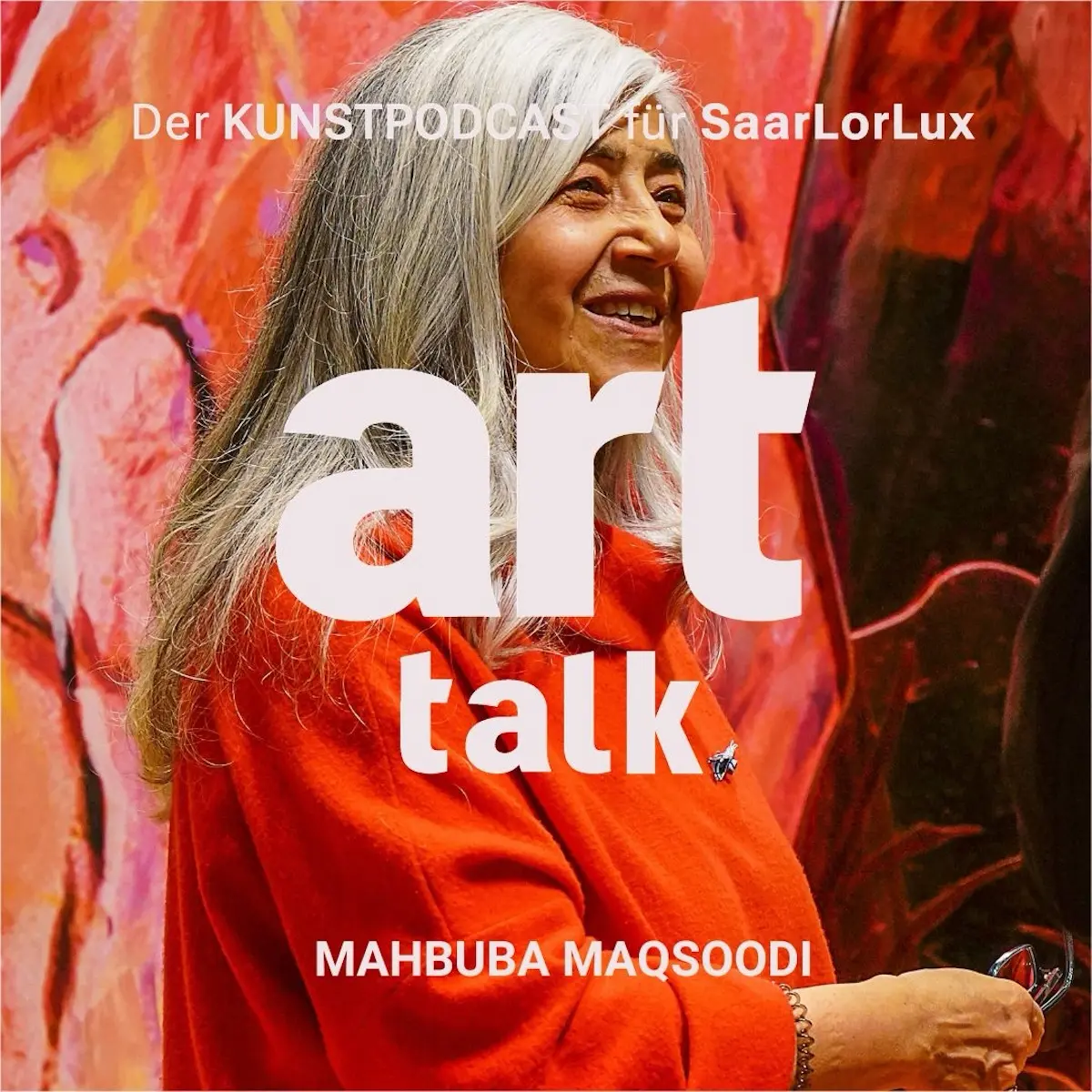
The visual worlds of the internationally renowned Afghan-German artist Mahbuba Maqsoodi
Mahbuba Maqsoodi is a painter, author and a bridge-builder between cultures, as her art consistently forges connections. She was born in Afghanistan and now lives in Germany.
Mahbuba Maqsoodi came to the attention of a wider audience through an extraordinary project: the design of the stained-glass windows at the Benedictine Abbey of Tholey in the Saarland. It is a place that combines tradition, spirituality and contemporary art. At the same time, Mahbuba Maqsoodi is currently exhibiting her works at the Städtische Galerie Neunkirchen in the exhibition GLAUBHAFT (credible), where her artistic output can be experienced in all its facets.
We talk to Mahbuba Maqsoodi about art between religion and identity, about light and colour, about human questions and spiritual themes – and about a life journey marked by upheavals and creative and artistic new beginnings.
Shownotes:
- Mahbuba Maqsoodi: https://maqsoodi.de
- Benedictine Abbey of Tholey: https://www.abtei-tholey.de/abtei/weltkunst-in-der-abtei.html
- Neunkirchen Municipal Gallery: https://staedtische-galerie-neunkirchen.de/aktuell/
- Produced by art trailer feldbausch: https://feldbausch.com/
- Find all the art talk SaarLorLux art podcasts here: https://feldbausch.com/blog/
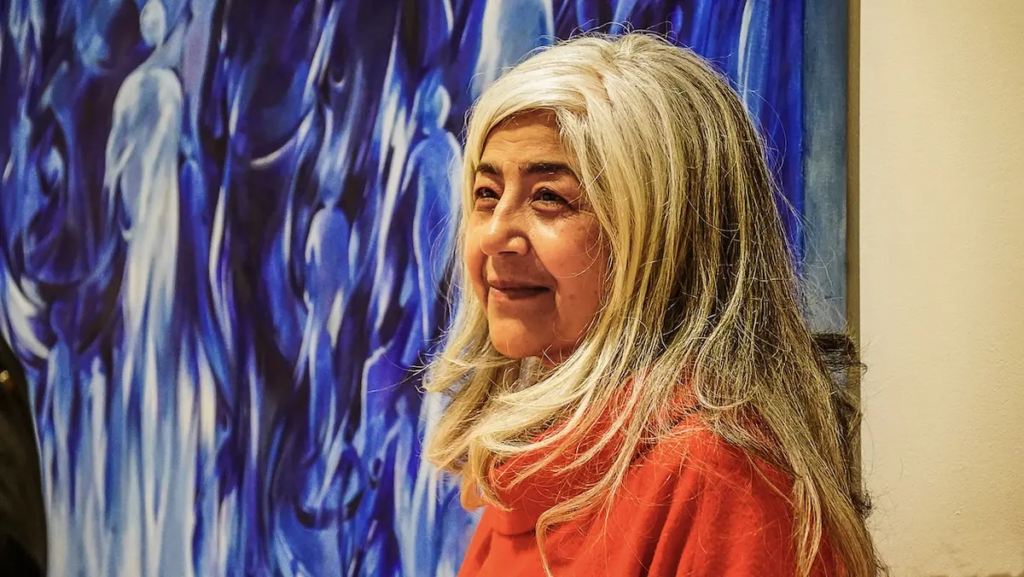
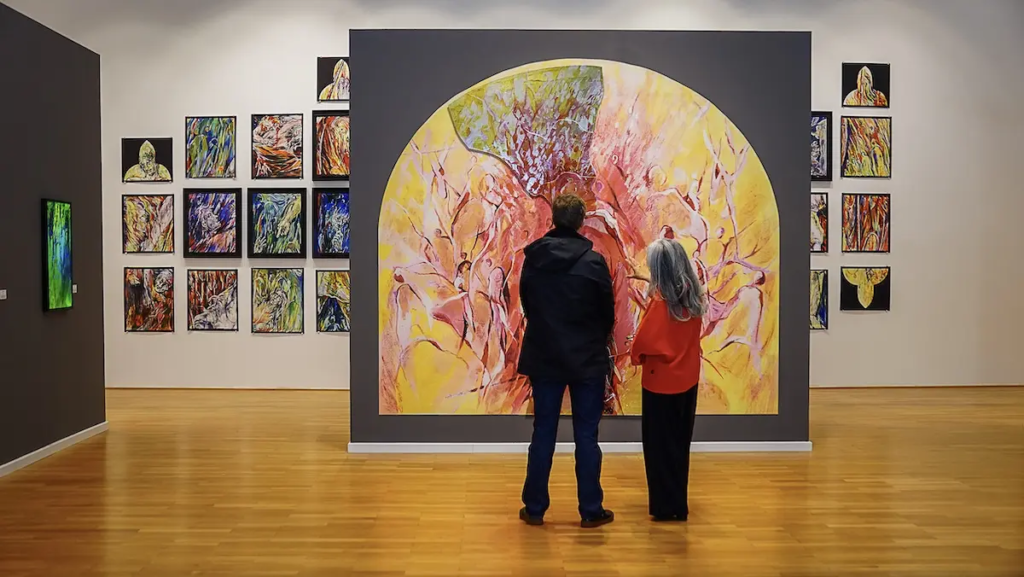
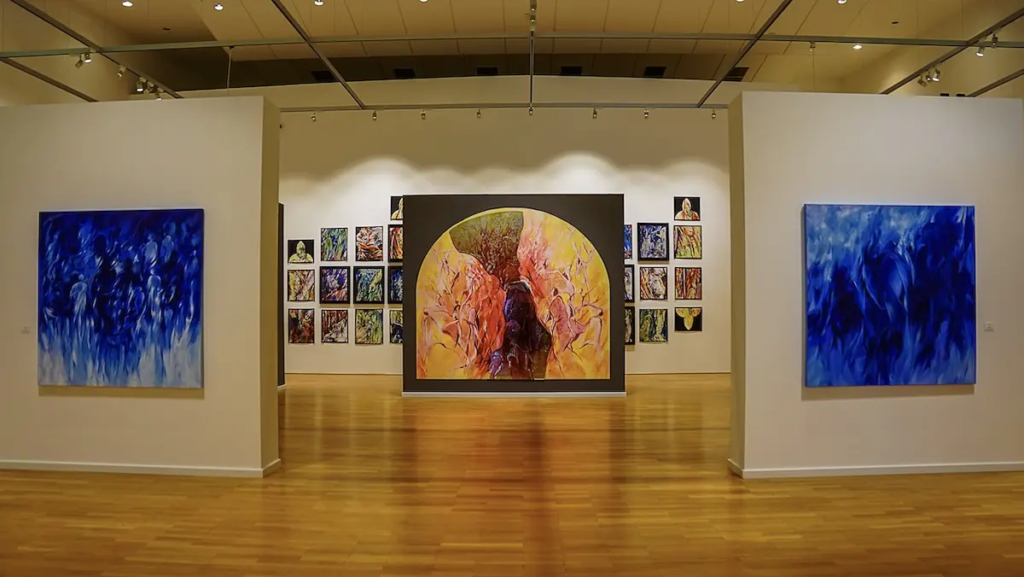
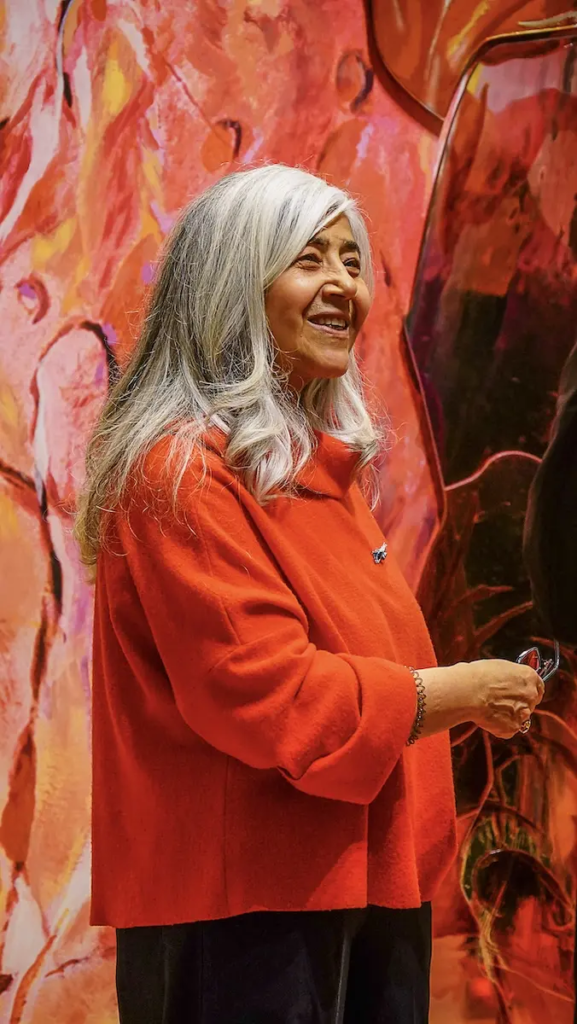
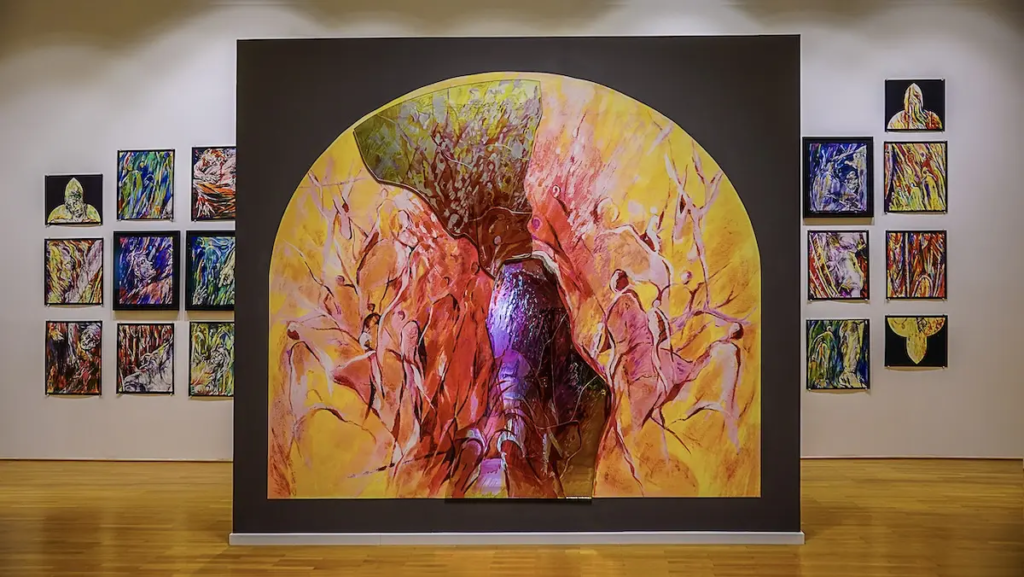
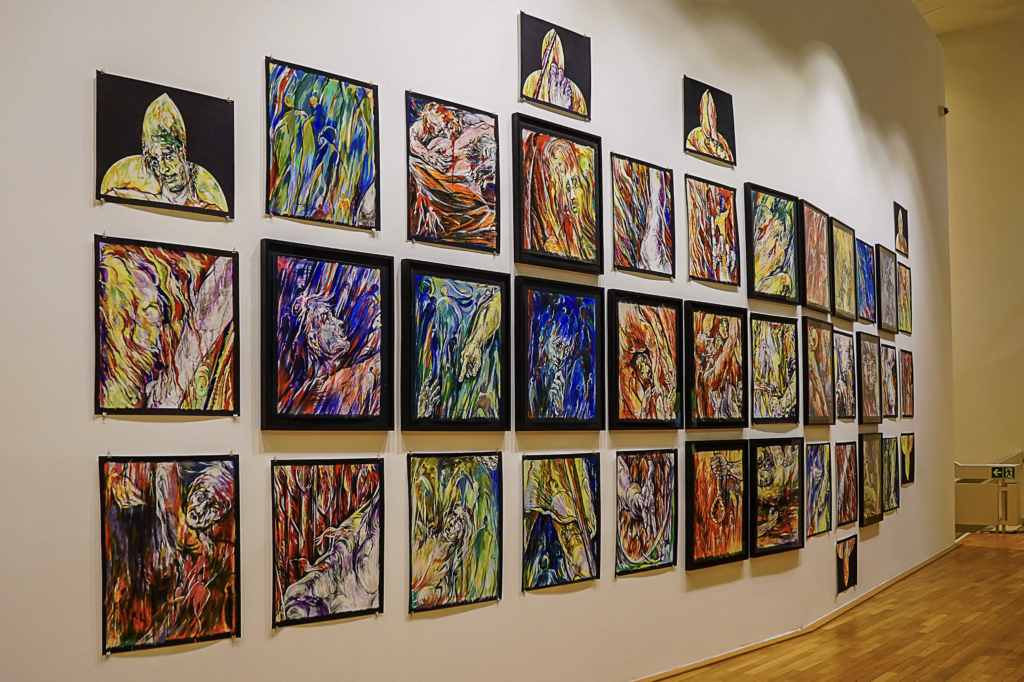
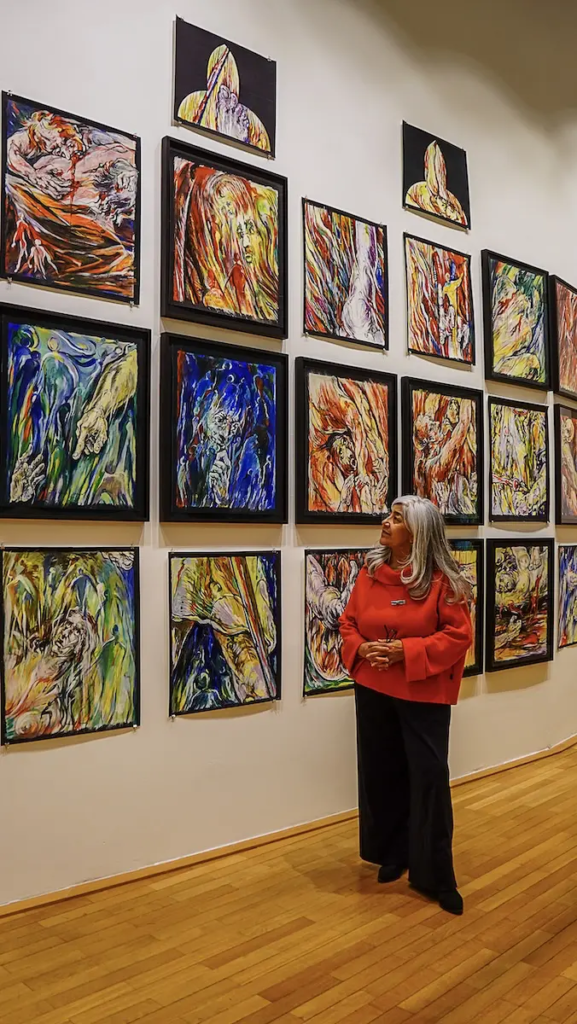
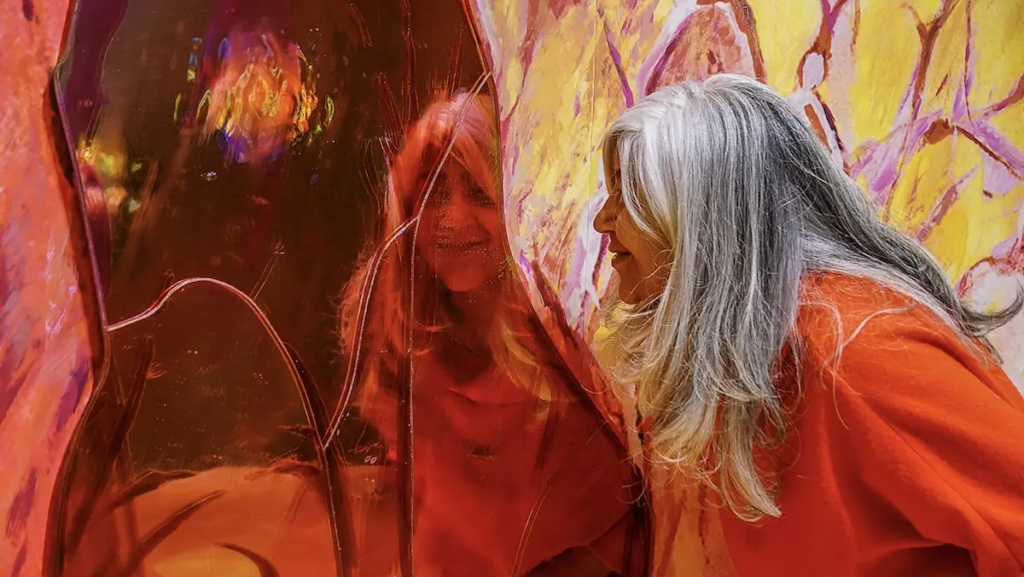
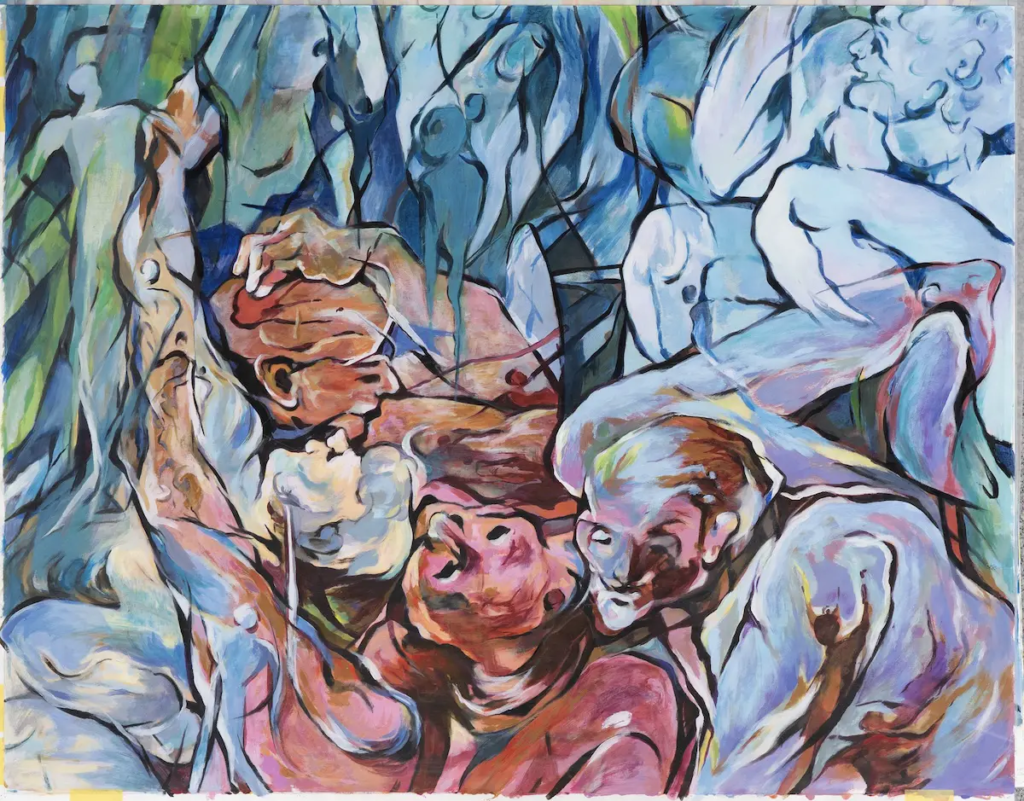
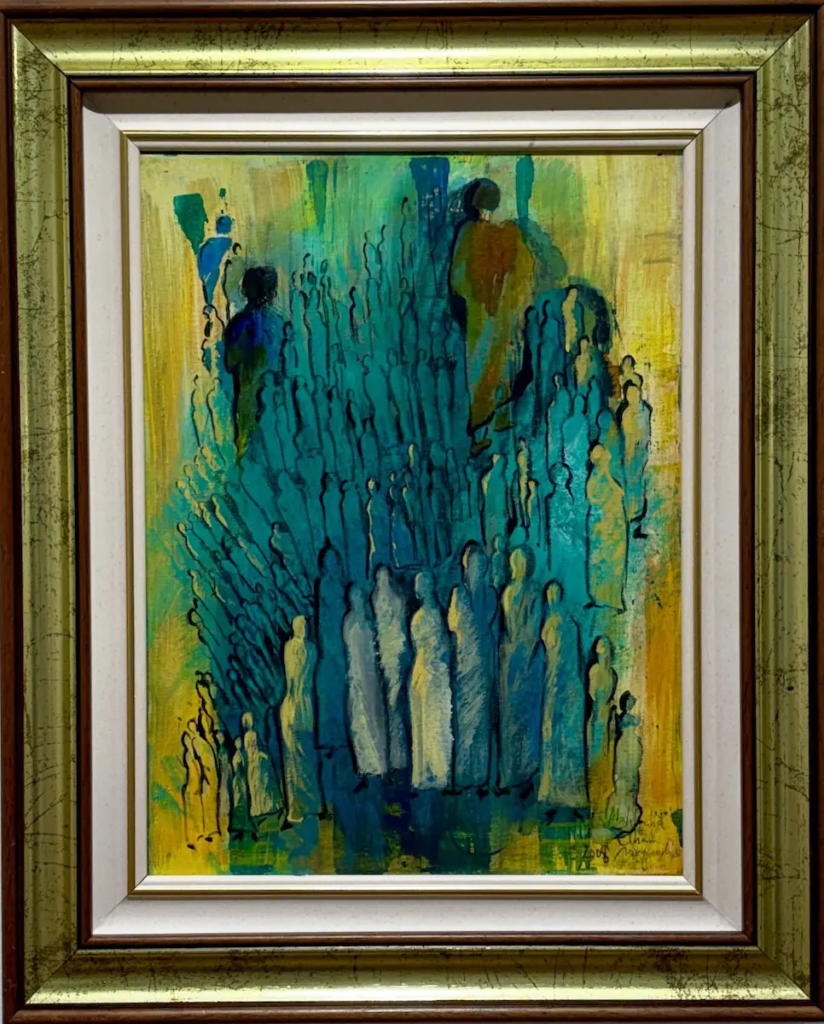
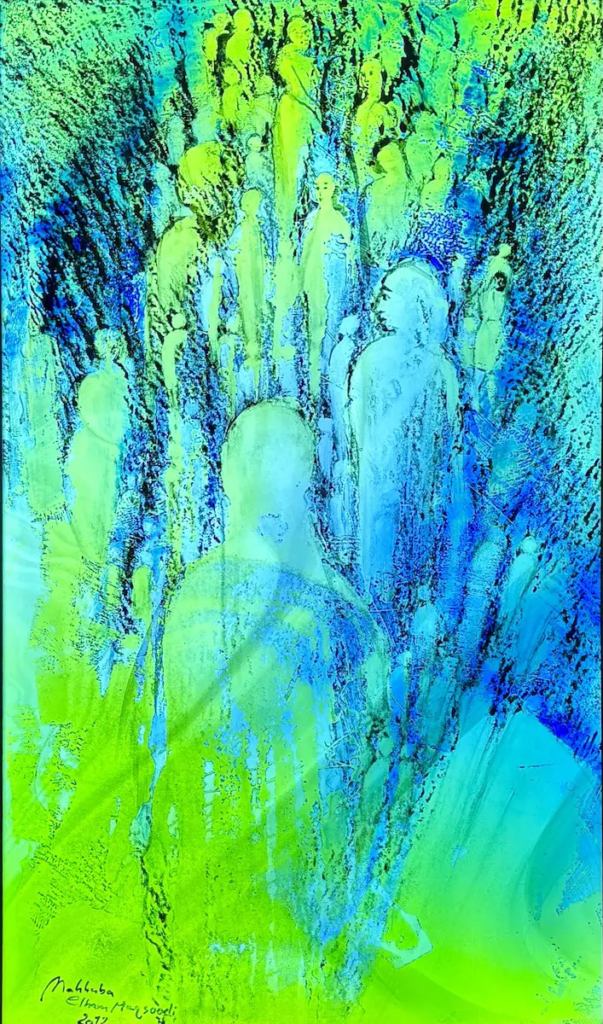
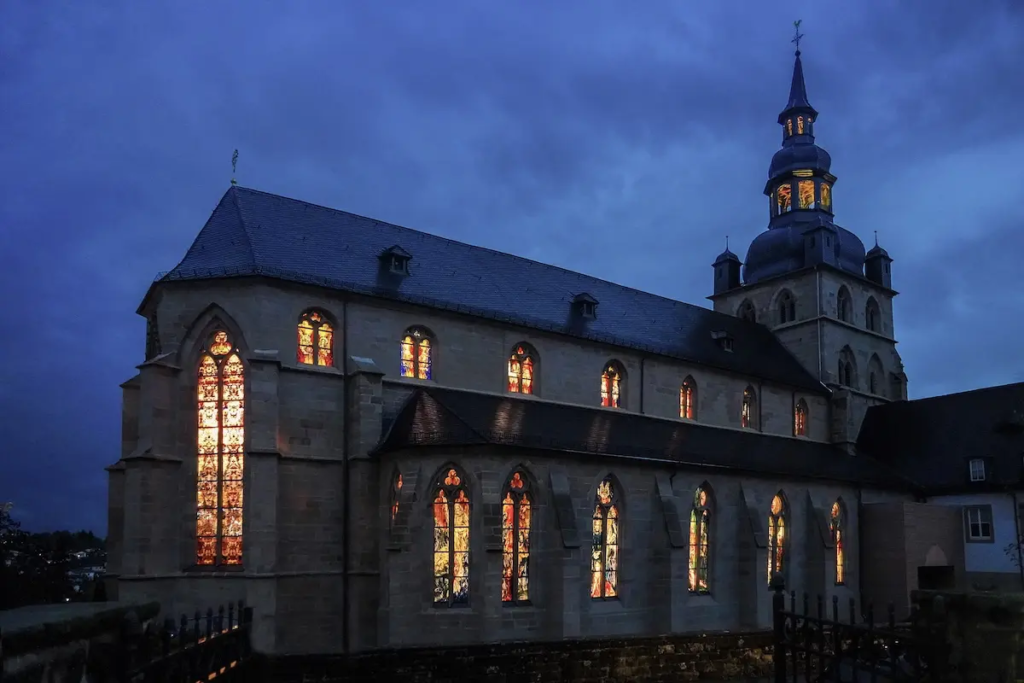
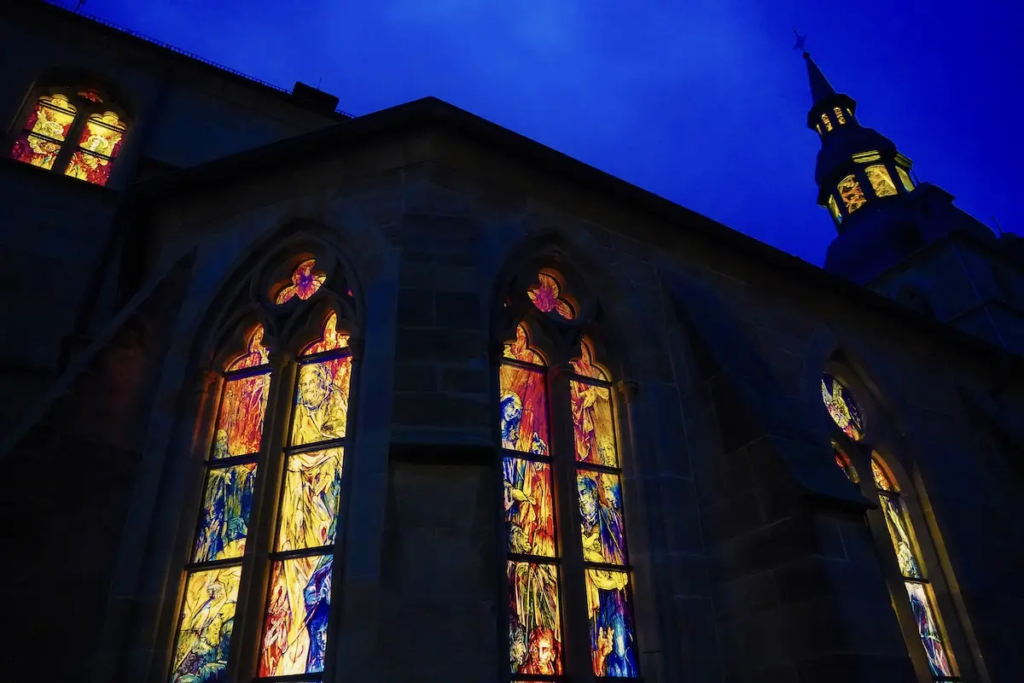
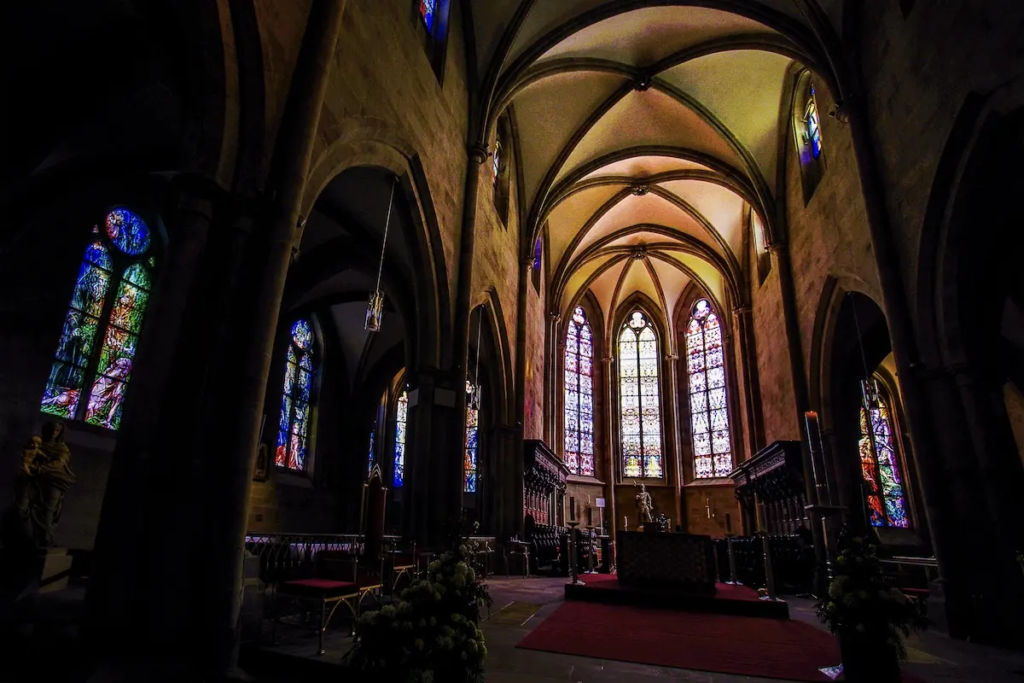
Foto Credits:
How to activate subtitles in your language
- If no subtitles appear, hover your cursor over the video window on a desktop or tap the video on a mobile device.
- Click the square icon to the left of the gear icon to turn subtitles on or off.
- The language normally adjusts automatically to your browser’s language settings.
- If it does not, you can choose your language by clicking the gear icon (Settings) > Subtitles > Auto-translate.
Bio – Mahbuba Maqsoodi: Bridging the Gap Between Herat and Munich
Mahbuba Maqsoodi is a contemporary artist who has gained international acclaim for her masterful fusion of Afghan tradition and European modernity. Her diverse body of work encompasses painting, drawing, and the design of sacred spaces through her artistry on glass.
Origins and Education Born in 1957 in Herat, Afghanistan, Mahbuba Maqsoodi completed her initial studies in pedagogy and art in her hometown. In the 1980s, she was awarded a scholarship to study in the Soviet Union, where she earned a doctorate in art history at the Academy of Arts in Leningrad (now St. Petersburg). Due to the political instability in Afghanistan, she sought political asylum in Germany with her family in 1994 and settled in Munich.
Artistic Practice Maqsoodi’s work is characterized by a profound exploration of human existence, femininity, and the search for identity between different cultures.
Painting on Glass: A prominent feature of her career is her work with glass. Maqsoodi is regarded as one of the few artists to have successfully translated the classical technique of stained glass into a modern, abstract, yet figurative visual language.
Style: Her images are often defined by delicate linework, vibrant colors, and a narrative depth that reflects influences from her Afghan heritage while remaining firmly rooted in Western modernism.
Significant Projects A major milestone in her career is the design of the stained-glass windows for Tholey Abbey in Saarland. While the designs for three large choir windows were created by the world-renowned artist Gerhard Richter, Maqsoodi designed the remaining 34 windows of the abbey.
“The windows tell stories of saints and biblical scenes, woven into a play of light and color that transforms the sacred space.” — Mahbuba Maqsoodi
Awards and Significance Mahbuba Maqsoodi has been honored several times for her cultural commitment and artistic achievements, including the Bavarian State Medal for Social Merit in 2023. She stands as an important example of successful cultural symbiosis, demonstrating how art can function as a universal language that transcends borders and political conflicts.
Today, she continues to live and work in Munich, where she handles both private commissions and large-scale public projects in her studio.
Read the full interview with Mahbuba Maqsoodi
We talk about art on art talk, the art podcast from SaarLorLux. We meet curators and artists at the venues where they are currently exhibiting. Join us as we explore contemporary art and unique art spaces in our region. Join us for gallery talks, exhibition openings, and closing receptions. You can listen to art talk anywhere podcasts are available.
Hello and welcome to art talk SaarLorLux, the podcast for art and culture in our greater region, where we talk to fascinating, creative people. My name is Verena Feldbausch, and today I have a very special artist as my guest. A woman whose life story is just as impressive as her art: Mahbuba Maqsoodi. She is a painter, an author, and a bridge between cultures, because her art truly builds bridges. She was born in Afghanistan and now lives in Germany. A wider audience, especially here in our Greater Region, became aware of Mahbuba Maqsoodi through an extraordinary project. The design of the stained-glass windows at the Benedictine Abbey of Tholey here in the Saarland. This is a place that blends tradition, spirituality, and contemporary art. At the same time, she is currently exhibiting her works at the Neunkirchen Municipal Gallery as part of the exhibition “Glaubhaft”, where you can experience Mahbuba Maqsoodi’s artistic work in all its facets. Today we’re talking about art at the intersection of religion and identity, about light and color, and about human questions and spiritual themes and a life journey marked by upheavals and creative and artistic new beginnings. As always, you can find images of the works discussed here on our blog; the link is included in the show notes. This episode of art talk SaarLorLux is sponsored by the Saarland Ministry of Education and Culture. We sincerely thank you for your support, which makes it possible to amplify artistic voices such as that of Mahbuba Maqsoodi and to strengthen cultural dialogue in our region and beyond. Well, I hope you enjoy listening.
Verena Feldbausch: Dear Mahbuba Maqsoodi, I am very pleased that you are here today. Welcome!
Mahbuba Maqsoodi: Thank you for the invitation!
First Impressions
Verena Feldbausch: I like to start off by being completely open. How are you? Right in the heart of the exhibition and your projects.
Mahbuba Maqsoodi: I feel comfortable and completely content.
Verena Feldbausch: Great!
Life Journey and Artistic Beginnings
Verena Feldbausch: You have had an extraordinary journey, from Afghanistan to Germany. You were born in Afghanistan in 1957 and studied Persian miniature painting there under your future husband. Was art something you were drawn to from the very beginning, or did that develop over time? How did you get started in the arts?
Mahbuba Maqsoodi: Yes, as you mentioned, it’s a very long way. And I think, from my first steps in miniature painting in Herat, to studying at the Academy of Arts in St. Petersburg, as my first conscious encounter with European art and culture, right up to experiences with art in Germany, all of these experiences have shaped my journey and led me to whom I am today—or how I feel today. But still, the path remains open.
Verena Feldbausch: Good!
Verena Feldbausch: In Afghanistan, the initial focus was on Persian miniature painting. Then you and your husband went to St. Petersburg in the former Soviet Union on scholarships. There, you explored European art and refined your artistic skills. So you’ve tried out different techniques in drawing and painting. And besides, you studied ceramic art there. What do you remember most clearly from that time?
Mahbuba Maqsoodi: When I arrived in St. Petersburg, as you mentioned, I’ve actually experienced something completely different: miniature painting. And it was in St. Petersburg that I first really came into contact with European art. That was a fresh start. I really had to catch up on a lot of things that my classmates had already completed, I had to learn it myself first. And that means a lot of work for me. Because I’m so curious and love trying new things, so I was ready to learn everything I possibly could. And at the academy, those doors were open almost 24 hours a day, yes. And I tried every day, taking every opportunity — in lecture halls, while painting, while drawing, in art history classes, and in the museum galleries. They say that the Hermitage alone covers 24 kilometers. And there is art ranging from antiquity to modern art. It was a sea of possibilities. And I tried to make use of everything, absolutely everything. And I’m grateful for that because, when I came to Germany, I was already familiar with European art and culture in many areas. Well, here in Germany I came across something on the subject and tried to learn more about it.
Arrival in Germany and Discovery of Glass Painting
Verena Feldbausch: Since you couldn’t return to Afghanistan, you came to Germany, where you initially worked in figurative and abstract styles before eventually discovering glass painting. Is that the right way to put it? How has this journey shaped your artistic perspective?
Mahbuba Maqsoodi: I think every stage of my life has shaped who I am today. It was conscious or unconscious, intuitive. As for glass as a medium, I had been exposed to it during my art history studies at the academy. I already knew the significance of glass in Gothic architecture during the early Middle Ages and beyond. My husband and I were both freelance artists. I’d say I came here with a full backpack. Suddenly, we found ourselves in a situation where nobody needed us in the way I had imagined, or in the way we had imagined. And that was the start of my search — the moment I discovered something new. That I will continue with my artistic pursuits nonetheless. And that’s how I came to work with glass. Making that first stroke on glass was an almost frightening experience for me because I was searching for the surface. Because glass lets light pass through. And that was the interesting, not easy — in fact, difficult — beginning.
Verena Feldbausch: The new one, too.
Mahbuba Maqsoodi: The New, of course. Exactly.
Art as a Necessity
Verena Feldbausch: When did you realize that art is more than just a form of expression for you — perhaps even a necessity?
Mahbuba Maqsoodi: Right from our first encounter, like a wave breaking over a small perfume bottle, I had the feeling that this had already happened in Herat when I was in 11th grade at high school. That was a coincidence, of course. From the very beginning, much of it appeared to me in lines that already contained color. Not just as a possibility, but as a quiet sense of unease. An inner compulsion that I can hardly resist — or ever could. And that continues to shape me.
Intuitive or Conceptual?
Verena Feldbausch: Do you work more intuitively or conceptually? Or is it a mix of both?
Mahbuba Maqsoodi: That’s a very good question. And I think most artists tend to work intuitively. Because for me, that’s what intuition means—it’s a matter of feeling. Working with art isn’t exactly scientific research. This intuitive approach helps build trust. What people generally call a gut feeling, I suppose. But I think that’s really just a matter of inner perception, which triggers and directs the initial impulse. But in the field of art and architecture — because that’s a really big project — not as individual images or a triptych, I think we need this concept, too. Yes, it’s a blend of intuitive and conceptual art. The space itself begins to speak, exerting an influence and demanding attention. In it, I seek not only form and structure within the space, but something that goes beyond that. The delicate harmony, the atmosphere that binds everything together. Everything. And brings harmony to the whole. As you said earlier, sometimes it’s a mix.
The Stained-Glass Windows in Tholey
Verena Feldbausch: One of your best-known works is the stained-glass windows at the Benedictine Abbey of St. Mauritius in Tholey. A project that has received a lot of attention. How did this project even come about? It’s not exactly an everyday project.
Mahbuba Maqsoodi: Yes, it was a Europe-wide art competition. And I was invited to participate.
Verena Feldbausch: Do you still remember the moment when you were asked to join? What was going through your mind at the time?
Mahbuba Maqsoodi: It wasn’t my first project in a sacred space. Yes. Before that, I also created several works in the style of 19th-century painting. With my husband, but also on my own. The difference was that, in this case, I designed in my own language and have thus turned my back on the painting of the past. Yes. My plan was to win it.
Verena Feldbausch: Great.
Mahbuba Maqsoodi: And I remember one day, with my painting under my arm, heading toward its realization. I went to Van Treeck’s workshop in Munich, thinking that these works would become part of the historic site. I was happy, yet humble. With a great sense of responsibility.
Verena Feldbausch: I think so, yes.
Reaction of the Monks and Community
Verena Feldbausch: Church windows have a long tradition. Your work thrives on the interplay of light and color. What was your initial idea for these windows?
Mahbuba Maqsoodi: For these windows in Tholey. The idea was, as always when I work in a space, that I would create my work to become part of the room. To me, that’s what harmony means. And that’s what the story is all about. And when I was there, right at the beginning, before I started designing, I had this feeling in the room — that I had to make something happen here, so that the spiritual could has an impact on everyday life. Because I don’t believe that religion and sacred spaces need to be kept separate from people. Because I think that when something like that happens, it completely loses the essence of the message. I tried to understand what the story meant in that sense. What is the theme here, and how can I present it in a contemporary way? Example. The story of Adam and Eve. This is an age-old theme in all three monotheistic faiths. And that was one of the works. I don’t think I could interpret these topics the way I used to, because I’m convinced that God created men and women as equals. And the rest is the work of humanity. So, equal rights, equal responsibilities. And that is how the entire cycle eventually came to be.
Verena Feldbausch: Oh, really? That’s nice. Very interesting, yes. Yes.
Light and Emotion
Verena Feldbausch: What role does light play for you in this context? So not just technically, but emotionally as well?
Mahbuba Maqsoodi: I think light is fundamental to existence. Well, we can’t do anything without light. And it is also an ongoing process that accompanies the creative work. Because light can also create something distinctive in the expression of the artwork, in the music, in painting. And that means it varies from person to person. And through this individuality — the way light is handled — one also creates an emotional expression. And this, of course, also gives rise to an emotional response to the image of the viewer. Yes. And of course, I hope that my work touches people in that way.
Religious and Spiritual Aspects
Verena Feldbausch: Were there any religious or spiritual aspects that particularly resonated with you personally in this work?
Mahbuba Maqsoodi: The thing is, everything I do in the arts — whether it’s in the field of art and architecture or individual images — spirituality plays a central role in my work. And when works are created for a sacred space — these sacred spaces, not all of them, but most of them, share this view of spirituality. So. And in a way, that further influences what I’m expressing in that sense. And regardless of the topic.
Experiences with Sacred Spaces
Verena Feldbausch: I have another quick question. You say that this isn’t the first religious building, so the windows of the first religious building, which you designed. Could you tell us a little bit about how it all started and how you got into it in the first place? How was it possible to design windows for churches?
Mahbuba Maqsoodi: That’s really a very valid and good question. As I said, I was looking for my path, and then I came across glass as a medium, and then I started working with a company in Munich that also has years of experience in the fields of art and architecture. And that is essentially how this collaboration came about, in the spirit of 19th-century design, because we, my husband and I, studied in St. Petersburg. And this 19th-century painting represents a bygone era in Europe, but in America, one talks about it a lot. So there’s contemporary art as well as 19th-century paintings. And that’s how we ended up with commissions — and I really mean commissions in the style of 19th-century painting. And several projects were launched, such as in Nashville, in Texas, and two other of the same kind. Chapters in the city of Albany, New York, private homes, and so on. So, as I mentioned earlier, the project in Tholey wasn’t my first experience. Only this time, it was my own language, which I had spent years developing.
Verena Feldbausch: Yeah, okay. Great, so we’ve cleared that up again. Exactly.
Reaction of the Monks and Congregation
Verena Feldbausch: How did the monks and/or the congregation react to your designs? Were there any discussions, or was there immediate trust?
Mahbuba Maqsoodi: When the jury’s decision was announced, there was absolutely no discussion between me and the convent. A deep, deep trust developed.
Verena Feldbausch: Ah, nice.
Mahbuba Maqsoodi: And this was clearly evident in the community also after the inauguration.
Verena Feldbausch: Great. So it was well received.
Mahbuba Maqsoodi: Yes, after the inauguration.
Verena Feldbausch: That’s wonderful.
Mahbuba Maqsoodi: I emphasize that.
Verena Feldbausch: That’s wonderful. Very nice.
Working Alongside Gerhard Richter
Verena Feldbausch: Tholey Abbey also has windows designed by the very famous artist Gerhard Richter. What is it like to design the windows of an abbey together with such an exceptional artist? So, side by side. You didn’t design it together. Did this project have any personal impact on you?
Mahbuba Maqsoodi: Yes, I think every project has a personal touch. Even every art talk and reading. For example, yesterday here in this wonderful room. For the first time, after having read several times in different contexts, I read it in a room, where my pictures hang. That was a completely new experience — a whole new perspective. And that’s exactly how it was with the project in Tholey. But I am convinced that every person and every artist, regardless of their fame, plays its own role and occupies — or is capable of occupying — a unique position in the world. As far as the experience is concerned, it has surpassed my expectations in many ways. For me, the result was a sense of harmony in which all the pictures in the room complemented one another.
Verena Feldbausch: Yes, that’s lovely.
Cultural Bridge
Verena Feldbausch: Would it be fair to say that this work also serves as a cultural bridge between your heritage and the European church community?
Mahbuba Maqsoodi: I think so. So far, we’ve been talking about how many different stages of my life have shaped me. And through all these stages — from Afghanistan to the Soviet Union and then here. Despite all the differences, I have always found something in common. And that is exactly what I am able to express through my work. Yes, we are different, but we have something in common. And I don’t think art could or can save the world. That is not the purpose of art; rather, the purpose of artists is to have something to say. And when I present my works — whether in sacred spaces or here in an exhibition — if people let go of their fixed positions just a little bit — even by a millimeter — then that’s wonderful.
Verena Feldbausch: Yes, that’s described very well. Thank you.
The “Glaubhaft” Exhibition in Neunkirchen
Verena Feldbausch: Now we’re heading to the exhibition at the Städtische Galerie Neunkirchen, where we’re also conducting this interview. In addition to this major religious project, you are currently exhibiting your work at the Städtische Galerie Neunkirchen as part of the exhibition “Glaubhaft.” Here we also find a number of drawings and sketches of the stained-glass windows in Tholey. What can visitors expect to see in your exhibition?
Mahbuba Maqsoodi: Yes, the thing is, because I work in the public eye, I’m better known for my art and architectural works. And now let’s talk about this exhibition. Visitors might suddenly see something that actually has nothing to do with it. That’s one side. My goal in this exhibition. Second, the works that are ultimately captured in glass have undergone an intensive process, which many people are unaware of. These are several design sketches; they are drawings that can ultimately be translated into fabric, glass, or another material. That’s actually what I wanted to show, because strictly speaking, they are already self-contained, finished works that are being transposed into a different medium.
Verena Feldbausch: Yes, that’s right. So here on the gallery you can see some sketches — probably pencil sketches? Yes. And here you can see acrylics too — again, just sketches or details, right?
Mahbuba Maqsoodi: The fact is, from the Tholey cycle, I’m presenting just a single work here: “Good and Evil,” also known as “The Fall of Satan.” Next to them, you can see these individual designs as they were ultimately rendered in glass in Tholey, so to speak. Yes. But I’ve broken down the entire window into 40 individual images and arranged them into a new composition next to it. What I meant to say was that my works can also function independently of the space. Each part is like a picture of its own.
Verena Feldbausch: Yes, exactly. Yes, that’s very interesting. You really have to check this out.
Mahbuba Maqsoodi: And now you can imagine — as far as I’m concerned, I had chosen for this work alone 63 study drawings. There are 40 on display here, and we have 29 pictures in Tholey. Well, I’m talking about over 350 study drawings and pictures, pictures, pictures. So there is a way to show additional presentations of these images.
Verena Feldbausch: Yes.
Central Theme of the Exhibition
Verena Feldbausch: Is there a common thread or central theme that runs through the works that we have here in Neunkirchen?
Mahbuba Maqsoodi: Yes. I am an artist who does not create decorative art, because I carry within me, by choice or not, conscious or unconscious, many things. And the source of my inspiration is my day-to-day interactions with people, with nature, with its concerns, its joyful feelings, and so on. And that is how I express it in my work. And that is why people are truly the common thread that runs through all of the works. By this, I also mean to say that we humans are part of the whole. But because humans possess a special creative ability, accordingly they are responsible. Small or large. Within the family, in society, or in world events. People play a key role in my work. Yes. People are at the center of everything.
Verena Feldbausch: Yes.
Identity, New Beginnings and Belonging
Verena Feldbausch: Your work often deals with identity, new beginnings, and a sense of belonging. How are these themes specifically reflected in the exhibition?
Mahbuba Maqsoodi: Because I was able to experience so much. Afghanistan, a country that, in some respects, may still be stuck in such archaic ways of thinking. Then again, you find there a reflection of the modern way of engaging with the world. Then Russia or the Soviet Union. A different system. The perceptions we humans have of the outside world are completely different. But I lived there for about 14 years, and I got to know that society in all or many aspects. Then I’ll come over. In the end, as I said before, I see everything as part of a complex whole. When you look at the Earth from above, it’s wonderful, and you can’t see the borders. Perhaps the differences. And that is how I see these differences as well, as something that enriches us and adds to our lives. And I’m really searching for my identity there, too. In the things we humans have in common and that define us. And the differences are simply beautiful. I’m a painter, after all. How boring it would be if everyone were the same.
Verena Feldbausch: That’s right. You’re absolutely right.
New Techniques and Motifs
Verena Feldbausch: Are you working with new techniques and motifs here?
Mahbuba Maqsoodi: I’m always looking for new ones. This new situation keeps bringing something new to the table. Even though I work with color a lot, I actually see everything in color. I think new techniques come along sometimes, too. For example, how I work. If the fabric doesn’t let light through, but light is very important. In that case, for example, I’ll take the mirror. So new technologies are constantly emerging. And I hope that by working with glass myself, I can inspire my fellow artists to discover glass as a medium for their art as well.
Verena Feldbausch: Yes, as a new medium, exactly. As an alternative surface.
Free Work vs. Commissioned Work
Verena Feldbausch: How does your independent artistic work differ from a commissioned piece, such as the stained-glass windows in Tholey, for example?
Mahbuba Maqsoodi: Well, I don’t see any distinction. Because, as I said, I don’t approach the so-called biblical narratives in the same way as is perhaps customary in Christian iconography. I’m letting go of it completely. Yes, here’s what you can see in Tholey, here’s what you can see in Cham, and so on. Yes, the only limitation for me on this assignment is these technical constraints. For example, the window size. That’s just the way it is. So I have to stay within the format. Then, of course, the space — the atmosphere of the room — which also influences how I perceive my concept in terms of color. That’s about two restrictions. When it comes to interpretation, I have complete freedom, just as I do with individual images.
A Particularly Dear Work
Verena Feldbausch: Is there a piece in the exhibition that is particularly close to your heart?
Mahbuba Maqsoodi: That’s hard to say, too. When I really look closely, I think the message of this picture — which isn’t very big — is: Everyone goes their own way.
Verena Feldbausch: Shall we take a quick look?
Mahbuba Maqsoodi: Can we go there? Yes.
Verena Feldbausch: What does this work mean to you?
Mahbuba Maqsoodi: Yes, that was another step. The creation of these abstract figures, which are sometimes representational and sometimes not. And this idea that people go their own way really strikes a chord with me. As I said earlier: three cultures, three different perspectives on politics, the system, and religion. But time and again, I’ve noticed the same thing: that when people come together, they all move in the same direction. There are only a few who think: Oh, I have to take charge here and take responsibility. That is what I actually see as a viewer.
Verena Feldbausch: Yes. The painting is titled “The Path” and was created in 2012. Yes.
Mahbuba Maqsoodi: Exactly. In 2008, I created a small canvas painting, and the first thing I tried after that was painting on glass.
Verena Feldbausch: Great.
Writing and Painting
Verena Feldbausch: You are not only a visual artist, but also an author and women’s rights activist. In 2017, you published your autobiography, titled “The Drop Knows Nothing of the Sea.” How do writing and painting complement each other for you?
Mahbuba Maqsoodi: Yes, that was a new experience for me, too. But as I said, I see everything in colors. The idea occurred to me that, rather than painting what I had experienced—or rather, what I had been allowed to experience—in small pictures, I should write it down instead. In the sense that I leave it up to the readers to interpret my words. They shall try painting themselves.
Verena Feldbausch: Interesting.
Mahbuba Maqsoodi: I receive a lot of feedback, and can you imagine that this feedback—the perceptions I get from people—finds its way back into my paintings. So one complements the other. Yes, that has a big impact on me.
Verena Feldbausch: Yes, that’s right. So when you read something, images form in your mind. And that’s interesting—that you’re integrating that again.
Verena Feldbausch: Great.
Personal Stories in the Art
Verena Feldbausch: Your artworks often tell very personal stories. How much of yourself is in it?
Mahbuba Maqsoodi: Yes, we all have our own personal stories. And this personal story is based on real-life events. With trust, with love, with hope. Even with the loss. These are issues that I’m not the only one who has to deal with or is dealing with. All of us are. And whether we like it or not, it shows up in our daily activities. But as a painter, of course, also in one’s paintings. Yeah, that’s kind of normal for me. Yes. And this, of course, creates a connection between the image and the viewer. Because if that’s the case, if I could express this thread, then this connection can be formed. And that brings us to the finish of the picture. Yes. I’m not saying that I finish the painting; rather, the end of the painting comes about in the perception of the person standing in front of the picture.
The Role of Origins Today
Verena Feldbausch: What role does your background still play in art today?
Mahbuba Maqsoodi: Yes, a lot. I think that growing up, I had a lot of thoughts like that, and they still stay with me today. Yes. Example. To treat one another with respect. In education, or rather in the family, I would say openness. Being curious about what other people do. That’s how I was raised. And perhaps not everyone born in Afghanistan is like that, but at least I am and that remains present in my world. Yes. But still, I want to say that artists are free, and I’ve long exceeded such limits.
Family Background
Verena Feldbausch: Just a quick question about your background. As I mentioned earlier, you were born in Afghanistan, and there are seven girls in your family. So your father and mother have seven daughters. Can you tell us a little more about that? Because I think that was a pretty unusual situation, too.
Mahbuba Maqsoodi: Absolutely. But time and again, whenever I say this sentence during a reading, that I was born into a family of seven sisters. I see, oh, so it’s not that obvious here either. Afghanistan was like that, and it still is. The nice thing is, in our family, that was never an issue, especially on my father’s part. Maybe for my mother, I’ve heard her mention a few times that she has other wishes too. But why my father? Unfortunately, I never had a chance to talk to him about that while he was still alive. Or did I not perceive the situation that way, or did I not give it much thought? I think he was a truly, truly devout person. As a Muslim, he believed in God. And if you believe this—whether you are a man or a woman—everyone is, so to speak, a gift from God. Whether some have fewer rights or more rights—these are, after all, events that have unfolded throughout history and were created primarily by men. That is why women do not hold the same status as men in any monotheistic religion. My father interpreted it differently and didn’t leave any room for it at all within the family, to discuss that. That wasn’t an issue. And if you’re so convinced, so others outside our family, in the village or in the city, never asked him a question like that because he was so convinced. And that’s exactly what he conveyed. And that’s how I was raised. Because you said earlier that I might also be an activist—though I really don’t see myself that way, how it is perceived by an activist or a feminist. I really do see that the world consists of both genders and the two of them share the responsibility of shaping their lives and have different personalities, also as a gender. But that doesn’t mean that rights are being restricted. And that’s my attitude. And the same goes for Afghanistan. And I think that in Europe, we haven’t yet achieved the same level of women’s rights as men have, if the men hadn’t helped out. Yes. Imagine the 1960s and 1970s. That’s exactly what’s happening in Afghanistan, too. We’re always talking about women. I’m asking, where are the men? Yes. Because, really, they’re the ones to blame. So then we also need to discuss this issue with men and make sure they understand what their role is. And, of course, women too—so that they don’t always see themselves as subordinate, but rather deal with it consciously. That is my wish. And I think this issue arises even in sacred spaces, to the extent that it can. That men and women have equal rights, mindful of their rights and responsibilities. Yes.
Current and Future Projects
Verena Feldbausch: What are you currently working on, and what are your next projects?
Mahbuba Maqsoodi: I am currently working on a group exhibition that will take place in Cologne in September. The subject is the border, too. Should we stay within the border or not? Yes, that is a very profound exploration in this exhibition. I will be exhibiting there with an installation in a room. And then, next year, there will be an exhibition at the Museum of Modern Glass in Linnich. A solo exhibition. I’m also busy figuring out what else I can showcase from what I have. And then, there are talks about it; there might also be an exhibition in Chiang Chin, China. And as for projects, yes, there is a wonderful project currently underway for the Franciscan convent in Reuthe. Oh, right. And it’s called “Spaces of Silence”; it will be open to everyone, regardless of faith, nationality, and so on. I have titled this work “Lifelines.” My aim is to connect the history of this monastery, which was founded several hundred years ago, with the present day and also with the future. Everyone is excited to be part of it, and the grand opening will take place next year.
Verena Feldbausch: Nice, a really nice project.
The Message of the Art
Verena Feldbausch: What do you hope people will take away from your art—both here at the Neunkirchen exhibition and, more generally, when they view your works?
Mahbuba Maqsoodi: If my work can inspire people to think, that makes me happy—and in that sense, that is also my hope.
Conclusion
Verena Feldbausch: Thank you very much, Mahbuba Maqsoodi, for the lovely conversation.
Mahbuba Maqsoodi: Thank you.
Verena Feldbausch: If you’d like to learn more about Mahbuba Maqsoodi’s art, it’s well worth visiting the exhibition at the Städtische Galerie Neunkirchen and, of course, stopping by the Benedictine Abbey of Tholey to see the impressive stained-glass windows in person. As always, you’ll find a link to my blog in the show notes, where you can see photos of the works we discussed and, of course, links to the places where you can view Mahbuba Maqsoodi’s art. That was art talk SaarLorLux. If you enjoyed this episode, please subscribe to the podcast and feel free to share it. Thank you for listening, and see you soon, Verena Feldbausch.
Did you enjoy art talk? Then leave us a 5-star rating and recommend us to your friends. You can find more information about the podcast in the show notes and on our blog. Join us again when we talk about art on art talk, the art podcast from SaarLorLux.
-END-


